

Vous voulez une version française de cette publication ? Rendez-vous ici.
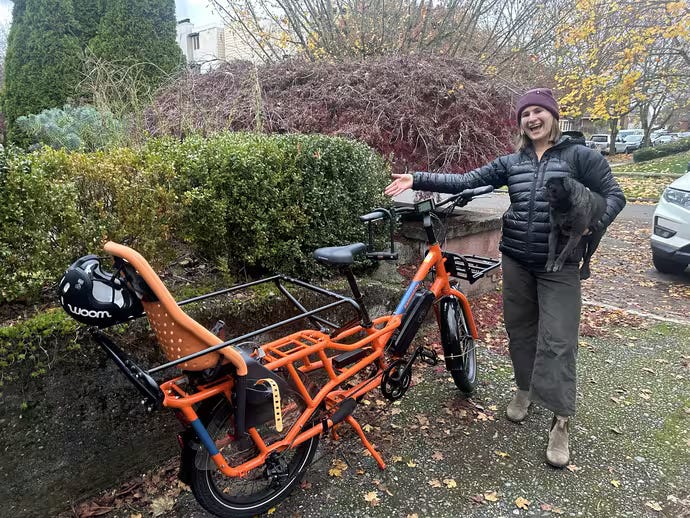
When Mackenzie Becker’s cargo e-bike was stolen, it wasn’t just transport that disappeared—it was a daily ride for her, her partner, their young child, and the family pug.
Many of us know that feeling. A stolen bike is more than a missing possession—it disrupts mobility, routine, and the everyday travel families rely on.
Mackenzie filed a police report, started an alert in 529 Garage, and did what most of us would do—scrolled through Craigslist, Facebook Marketplace, and OfferUp. Nothing. Then she tried something new: 529 Detective.
“I used the Detective feature from 529 and FOUND MY BIKE!!! It was being sold in a different town with some of the components removed—they took our Thule Yepp seat, the deckpad, and our front basket. The police were able to assist us!!”
— Mackenzie Becker, Oct 31, 2025
At Project 529, we hear stories like this every day. The details differ, but the pattern is the same: stolen bikes often appear quickly on online resale platforms.
The problem: more stolen bikes than police can realistically track
Officers we work with see the scale of bike theft every day. Stolen bikes appear on multiple online marketplaces within hours. Listings move quickly, parts are swapped, and bikes can be sold long before anyone has time to detect them.
Law enforcement simply can’t monitor the volume of posts appearing online. The burden of searching—unfairly—often falls on the victim.
Why online resale is such a powerful outlet for stolen goods
Online marketplaces have become major destinations for stolen property—not just bikes but electronics, tools, and everything in between—because they’re built around convenience, not verification.
Independent investigations estimate that more than $500 billion in stolen or counterfeit goods flows through platforms like Facebook Marketplace, Craigslist, and eBay each year. It’s not all bikes—far from it—but the scale matters. Police agencies across North America report that these sites have almost no built-in anti-theft safeguards: they don’t require serial numbers or proof of ownership, they don’t check listings against stolen-property databases, and cooperation with officers is often limited.
As Det. Paul Dolbey of the Portland Police Bureau said in an ABC News investigation, Craigslist had essentially become “the ultimate pawn shop,” because high-value items can be listed with almost no scrutiny.
This lack of verification is a major reason stolen bikes blend into legitimate listings so easily.
What 529 has seen behind the scenes
Years ago, we gathered more than 50,000 signatures asking Craigslist and eBay to introduce basic protections like serial-number fields and stolen-bike checks. They didn’t take action.
Elsewhere, regulators are beginning to take a harder line. In Taiwan, for example, authorities recently fined Meta for failing to remove fraudulent ads on Facebook, signalling a shift toward holding platforms accountable when their systems enable scams. We’d welcome similar responsibility from the large marketplaces where stolen bikes routinely appear.
Every week, riders in our community email us saying they’ve spotted their stolen bike online—and in most cases, the platform does little to help.
That’s why we partner with platforms like sprocket.bike, which verifies serial numbers against the 529 registry before a listing goes live. It shows that marketplaces can take theft seriously—they just rarely do.
What thousands of real recovery stories reveal
Because riders report recoveries back to us, we see patterns others can’t. From more than 2,200 recovery stories, clear patterns emerged in how stolen bikes are found. A significant share begins with a listing that may only be online briefly—sometimes just minutes.
How stolen bikes are recovered
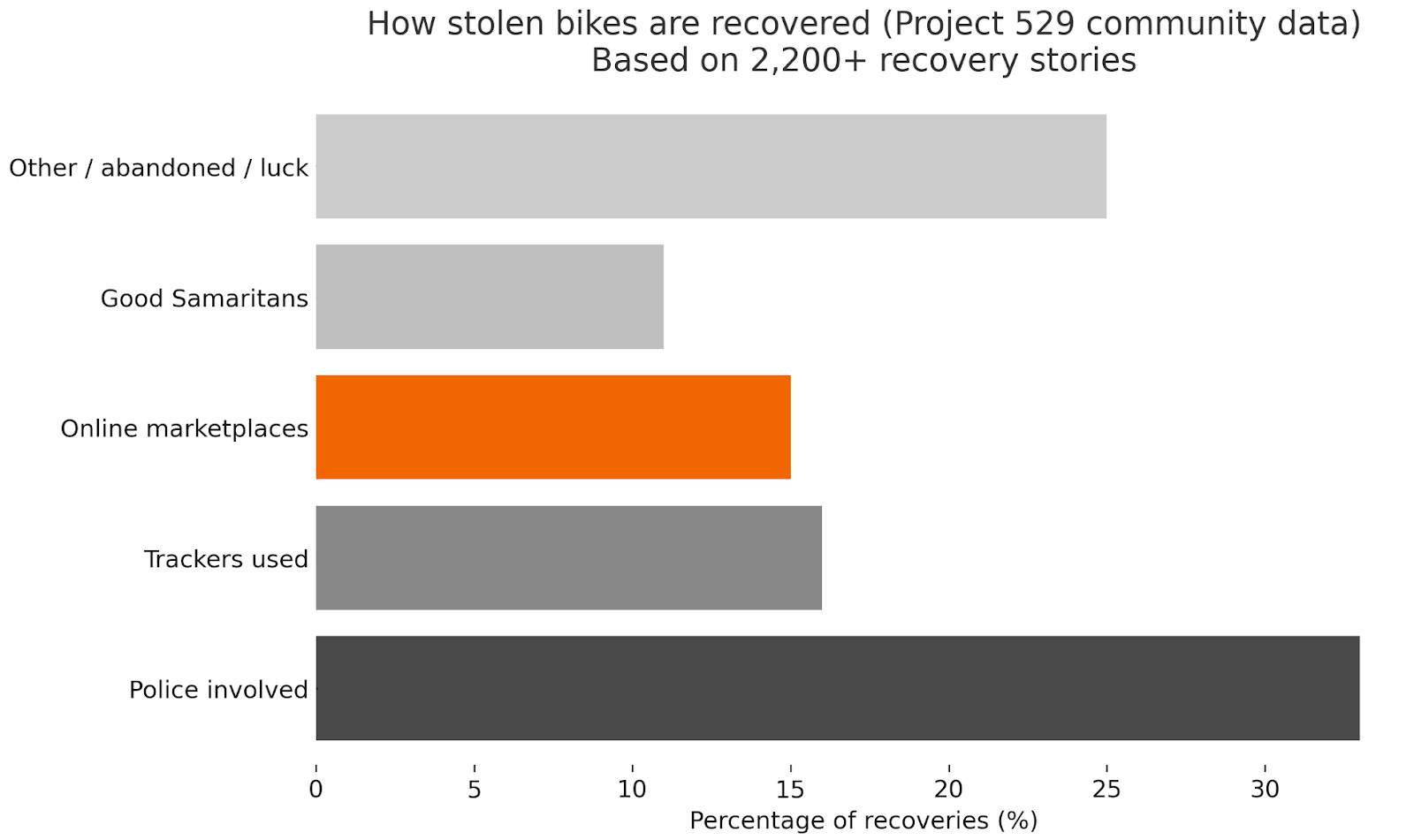
Based on more than 2,200 Project 529 recovery stories reported by riders across North America. Percentages represent the primary recovery pathway.
You told us what you needed—so we built it
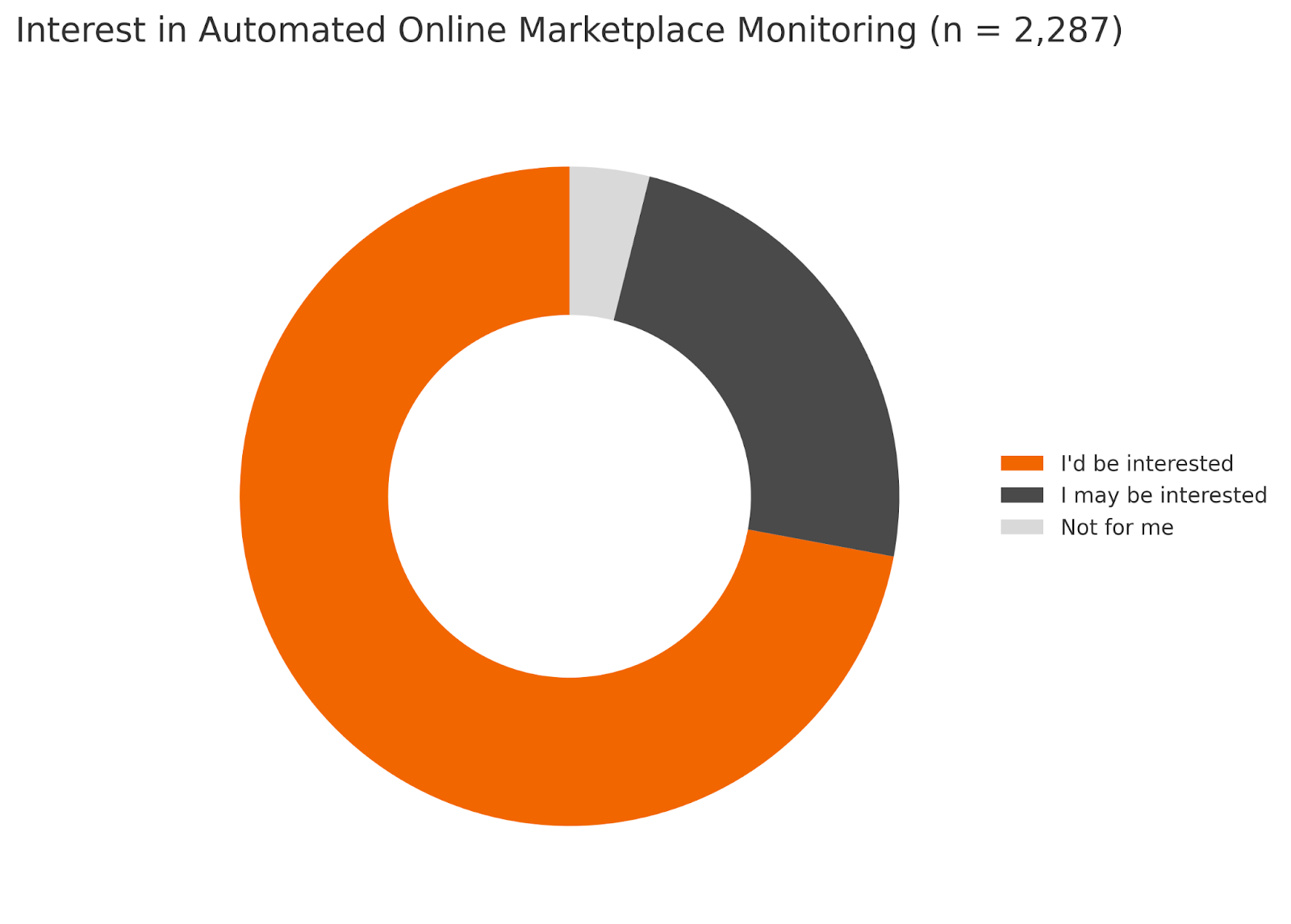
When we surveyed our community, the message was clear. Ninety-three percent of you said automated marketplace scanning would make the biggest difference after a theft.
So that’s what we built. 529 Detective is a direct response to what you asked for—a tool designed to take some of the burden off riders when they need support most.
What riders want after a theft
Project 529 community survey (n = 2,287). A combined 93.6% of riders expressed interest in automated marketplace scanning to help locate stolen bikes.
Why stolen bikes vanish into the noise
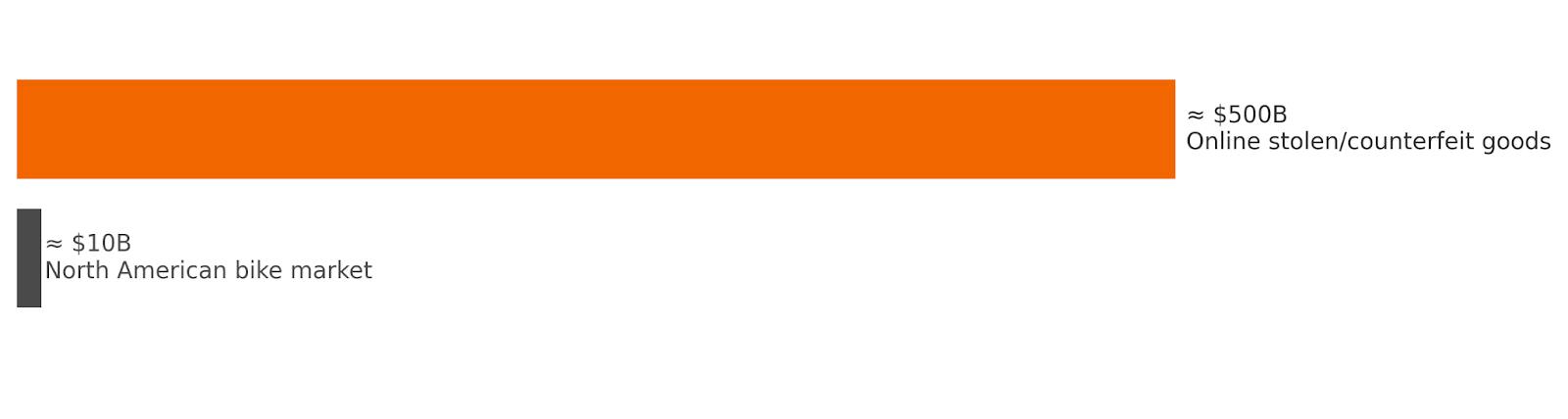
Independent analyses estimate that more than $500 billion in stolen or counterfeit goods flows through online marketplaces each year. It’s not all bikes—but it’s the environment stolen bikes move through.
For comparison, the entire North American bicycle market is worth roughly $10 billion annually (NBDA & Deloitte). In other words: The online resale economy is roughly 50× larger than the legitimate bike market.
This mismatch helps explain why stolen bikes can be so difficult to trace.
Scale: the online stolen-goods economy vs the bicycle market
A visual comparison showing why stolen bikes disappear into the noise online. OECD/EUIPO estimate the global counterfeit/stolen-goods economy at roughly $500B annually—nearly 50× the value of the entire North American bicycle market (~$10B).
A smarter way to search
Until now, searching for a stolen bike meant hours of scrolling and hoping. Thieves move fast, listings move faster, and the chances of recovery drop as time passes.
Once a bike is reported stolen, 529 Detective continuously scans major resale marketplaces across the US and Canada, comparing listings with your bike’s photos and details. It shows potential matches in a single dashboard, updates you daily, and makes it simple to filter results and share promising leads with police.
A one-time fee covers six months of active scanning—no subscription required.
Why we built Detective
529 Detective didn’t begin as a product idea—it came from the real-world frustrations we saw in policing and in our own lives.
Before joining Project 529, Rob Brunt, now our Chief Outreach Officer, spent years with the Vancouver Police Department. He remembers rooms full of recovered bikes with no way to link them to owners. Registration through 529 Garage solved part of that problem. Detective tackles the other half: finding the bike in the first place.
The personal side has always been just as clear. Years ago, one of our co-founders had his bike stolen and spent days searching online listings with friends until they finally found it—an effort that ultimately uncovered a larger fencing operation. Later, a break-in at founder and CEO Lara Ferroni’s home reinforced the same reality. Among the items taken was a retirement watch belonging to her husband’s grandfather. She and her husband spent weeks searching online until they spotted some of the stolen items. Police recovered part of what was taken, but the process was long and draining.
These experiences matched what thousands of riders have told us: stolen items do appear online—but finding them is exhausting and time-consuming. Detective was built so riders wouldn’t have to make that search alone.
Already finding bikes
Within days of launching, 529 Detective began surfacing matches that volunteers might have taken hours or days to spot. Some appeared within minutes.
Every recovery has a real impact—kids returning to their school rides, commuters getting back to daily trips, and fewer stolen bikes circulating online.
What 529 Detective does
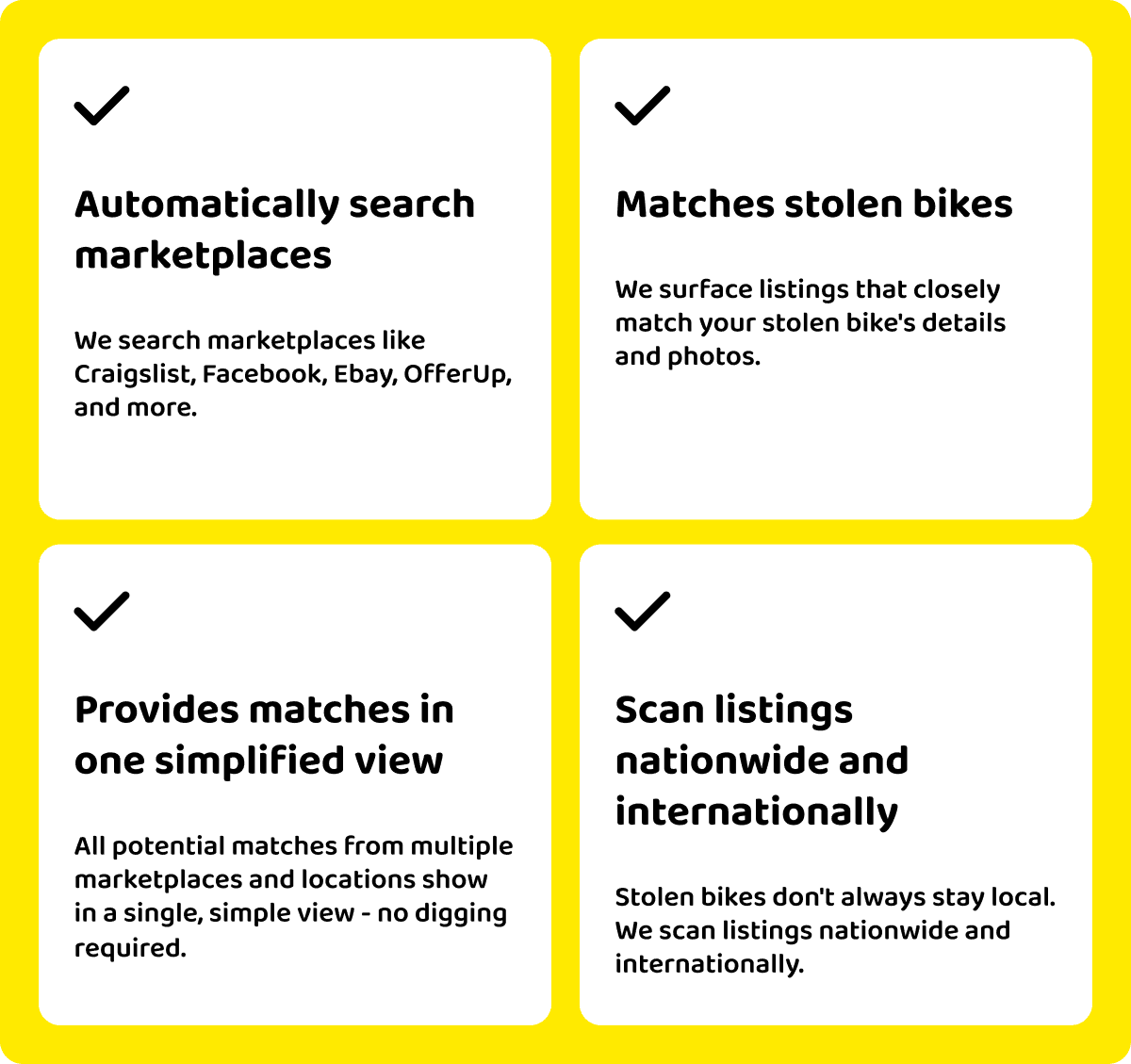
529 Detective is the tool riders have been asking for: an automated search partner that watches the resale world so you don’t have to.
It scans major marketplaces across the US and Canada, compares new listings with your bike’s photos and details, and flags anything that looks suspicious—all in one simple dashboard.
In short: Detective does the time-consuming work most riders and officers can’t realistically take on, working continuously for six months on a single activation, and giving stolen bikes a far better chance of being found.
Fighting bike crime together
Detective builds on what already makes the 529 ecosystem strong: riders who register their bikes, volunteers who keep an eye out, and officers who act on leads. Now that vigilance extends into the online world—where many stolen bikes appear first.
As Lara puts it:
“Recovery is possible, and we’re all part of the solution. Technology helps, but it’s powered by people.”
We’re working to reduce the distance between a theft and a recovery.
How to find my stolen bike
529 Detective helps you find your stolen bike. Put Detective to work for you here.

Fantastic initiative! Thanks for creating it
Good work! The cost adds up if you haven’t insured your bike though.